How Touchless Vital Sign Monitoring Prevents Silent Health Risks in Senior Living
Resident safety in senior living communities depends on the ability of care teams to consistently detect early signs of clinical decline. Yet in high-demand environments—where staff balance medication administration, cognitive support, and daily care—routine vital sign monitoring is often subject to inconsistency, delay, and human error. These gaps are not trivial. In older adults, small physiological changes—such as a two-pound weight increase or a slight drop in oxygen saturation—can signal the early stages of serious conditions. When these indicators are missed or inaccurately recorded, opportunities for early intervention are lost, frequently resulting in avoidable hospitalizations and worsening health outcomes.
The Hidden Risk: Inconsistent and Manual Monitoring
Traditional vital sign collection relies heavily on manual workflows in inherently unpredictable environments. This introduces several systemic risks. Manual transcription errors remain a significant concern, with NIH research showing error rates of 18.75% (PubMed ID: 24080751), a meaningful margin when clinical decisions depend on accuracy. Under time pressure, staff may unintentionally backfill documentation or rely on prior readings rather than capturing real-time measurements. In larger communities, ensuring that each data point is correctly matched to the right resident continues to present operational challenges.
These issues create blind spots where “silent” health risks develop. Conditions such as congestive heart failure (CHF), dehydration, and respiratory infections often emerge through subtle trends rather than obvious symptoms. Without reliable, real-time data capture, these early signals go undetected. The consequences of inaccurate or missing data—especially weight—are clinically significant and include diagnostic errors, medication dosing errors, and delayed interventions caused by post-visit documentation.
A Shift Toward Automated, Touchless Monitoring
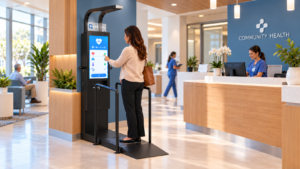
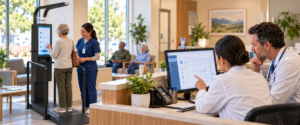
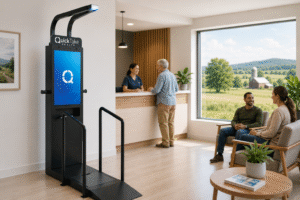
To address these challenges, senior living operators are increasingly adopting automated, touchless solutions that remove variability from the data collection process. QuickTake Health has developed a smart health assessment kiosk designed specifically for senior living environments. Using advanced camera technology and biometric authentication, the system captures a comprehensive set of vital signs in approximately 15 seconds without the need for invasive devices or manual input.
When a resident approaches the kiosk, they are identified through secure facial recognition, ensuring that every measurement is accurately attributed. This eliminates both documentation errors and identification gaps, establishing a reliable foundation for clinical decision-making.
High-Frequency, Frictionless Assessments
The speed and ease of use fundamentally change how often and how consistently vitals can be captured. Within seconds, the system records:
- Weight and BMI to detect fluid retention and nutritional changes
- Heart rate and ECG to identify cardiovascular stress or arrhythmias
- Pulse oximetry (SpO₂) to detect early signs of respiratory decline
- Body temperature to identify infection or inflammation
- Cognitive and mood inputs to provide insight into mental and emotional health
By digitizing and synchronizing these measurements, QuickTake enables the creation of a continuous, high-resolution health profile for each resident, supporting a transition from reactive care to proactive, trend-based intervention.
From Data Collection to Clinical Awareness
Accurate data must also be actionable and verifiable. QuickTake creates a Verified Health History in which each data point is time-stamped, linked to biometric identity, and supported by visual confirmation.
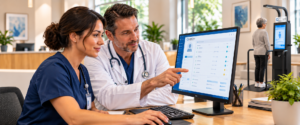
This structured dataset strengthens compliance and audit readiness for executive directors, enables clinical leads to quickly identify residents deviating from baseline, and reduces administrative burden for staff by eliminating manual charting. As a result, caregivers can spend more time focused on direct resident interaction.
Remote Monitoring and Family Transparency
Automated monitoring also addresses a persistent challenge in senior living: the communication gap between communities and families. Through secure, real-time access, authorized family members and off-site clinicians can review verified health trends remotely. This enables more informed conversations and earlier interventions when subtle changes emerge.
The result is not only improved care coordination but also increased trust and transparency between communities and the families they serve.
Industry Momentum and Innovation
The shift toward touchless monitoring reflects broader healthcare transformation trends, including initiatives such as CMS’s “Kill the Clipboard” movement. QuickTake Health’s approach aligns with this evolution and has gained traction through selection into leading HealthTech accelerators such as Fuel HealthTech and LG NOVA, engagement with the National Institute on Aging (NIA) to support aging-in-place innovation, and early adoption by organizations including Rice University, McNeese State, and The Villages of Imperial Pointe.
This momentum reinforces a critical reality: improving outcomes in senior living will not come from increasing labor, but from deploying smarter, automated systems.
Conclusion
Transitioning from manual to touchless vital sign monitoring is not just an operational improvement—it is a clinical imperative. Consistent, accurate data capture enables earlier detection of health decline, reduces avoidable hospitalizations, improves medication safety, and strengthens regulatory compliance. Most importantly, it enhances the quality of care delivered to residents by ensuring dignity, safety, and proactive health management.
Silent health risks thrive in environments where data is inconsistent, delayed, or inaccurate. By eliminating manual workflows and introducing automated, touchless monitoring, senior living communities can close these gaps. QuickTake Health empowers organizations to:
- Improve clinical accuracy and reduce risk
- Enhance patient engagement through intuitive, self-service experiences
- Enable proactive, data-driven care delivery
In just 15 seconds, a routine interaction becomes a meaningful clinical insight, transforming how care is delivered and experienced.
Book a demo with QuickTake Health to see how touchless monitoring can elevate care in your community.