How Workflow Automation in Healthcare Reduces Clinical Errors
Healthcare teams work hard every day to provide safe and timely care, but many challenges happen through inefficient processes rather than a lack of skill. Manual documentation,
repeated data entry, delayed patient intake, and inconsistent records create unnecessary pressure for both staff and patients. Small workflow gaps can quickly become larger
problems that affect accuracy and efficiency.
Understanding how automated systems improve daily operations is essential for modern healthcare environments. This blog explains how automation supports smoother
workflows, reduces clinical errors, and helps healthcare teams focus more on delivering quality patient care.
Understanding Healthcare Workflow Automation
Every healthcare setting depends on a series of connected tasks that move patients through different stages of care. These tasks include patient check-in, vital sign collection,
documentation, and information sharing between departments. When these activities rely heavily on manual work, delays and mistakes become more common.
Workflow automation in healthcare means using technology to complete repetitive tasks that do not require clinical judgment. Instead of replacing healthcare professionals,
automation supports them by reducing routine work and making important information available quickly and accurately.
Healthcare workflow management has steadily evolved from paper-based records and manual data entry to intelligent systems that simplify everyday operations. As a result,
healthcare teams can spend more time caring for patients rather than managing repetitive administrative tasks.
Why Traditional Healthcare Workflows Often Create Clinical Errors
Many healthcare organizations face similar workflow challenges that affect both efficiency and patient experiences.
Some common issues include:
- Vital signs are recorded manually and entered into electronic records
- Patients wait longer because staff members are occupied with repetitive
- The same questions are asked multiple times when information does not transfer
- Human error can lead to missed or incorrect vital sign
- Busy intake periods slow patient flow throughout the
- Administrative responsibilities contribute to staff fatigue and
These problems happen because manual processes create unnecessary delays throughout the patient journey, rarely because of a lack of expertise.
How Automation Improves Accuracy During Patient Intake
Patient intake is one of the first opportunities where workflow improvements can reduce clinical errors. Accurate information collected at the beginning supports better decisions throughout the care process.
Automation helps improve intake by:
- Guiding patients through structured health
- Collecting consistent information every
- Reducing manual typing and transcription
- Recording data in a standardized
- Making information immediately available for connected electronic healthcare
When patient information is gathered consistently, healthcare professionals can work with more reliable records, avoiding unnecessary delays.
Manual Work vs Automated Workflows
The following comparison shows how automated processes improve routine healthcare operations.
| Manual Workflow | Automated Workflow |
| Staff manually record vital signs | Vital signs are captured automatically |
| Information is entered into records later | Data syncs securely with connected electronic health record systems |
| Patients often wait for staff assistance | Patients complete guided check-ins efficiently |
| Documentation may contain typing errors | Standardized data improves consistency and accuracy |
| Staff repeat routine administrative tasks | Staff focus more on patient care |
How Better Data Reduces Clinical Errors
Accurate healthcare decisions depend on reliable information. Even small documentation mistakes can create confusion when information is incomplete or entered incorrectly.
Automation helps improve data quality by:
- Capturing information
- Reducing duplicate
- Minimizing manual
- Standardizing
- Supporting cleaner healthcare
Reliable information allows healthcare teams to review patient details with greater confidence while reducing avoidable administrative corrections.
Supporting Healthcare Staff Instead of Replacing Them
One common misunderstanding is that automation replaces healthcare professionals. In reality, automation removes repetitive administrative responsibilities while leaving clinical decision-making with trained professionals.
Healthcare staff continue performing the tasks that require experience, communication, and professional judgment. Automation simply reduces time spent on routine activities that add little clinical value.
Some important benefits include:
- More time for direct patient
- Less repetitive
- Reduced administrative
- Improved daily workflow
- Lower pressure during busy
By removing unnecessary manual tasks, healthcare teams can work more efficiently without changing the quality of clinical care they provide.
The Role of Smart Health Assessment Kiosks
Modern healthcare environments increasingly use automated tools that simplify patient check-ins and health assessments.
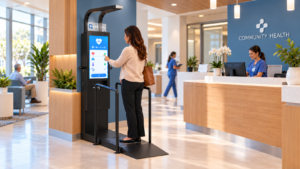
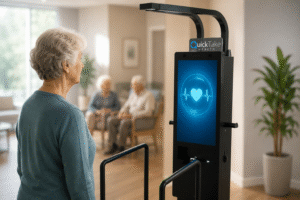
QuickTake Health builds smart health assessment kiosks that automate vital sign capture and data integration. The company was created to reduce inefficiencies and errors
commonly found in traditional healthcare workflows.
Its health assessment kiosks use biometric sensors, advanced camera technology, and facial recognition to automate collection. A 32-inch touchscreen guides users through quick,
contactless check-ins while securely syncing information with connected electronic health record systems.
By combining measurement, documentation, and engagement into one platform, QuickTake helps organizations collect accurate health information while supporting smoother daily
operations across healthcare, athletic programs, senior living communities, sports, and so much more.
How Workflow Standardization Improves Patient Flow
Healthcare environments become more efficient when every patient follows a consistent
process. Standardized workflows reduce unnecessary variation while improving reliability throughout daily operations.
Workflow automation in healthcare supports smoother patient movement by ensuring information is collected, stored, and shared in the same structured way each time.
This consistency helps healthcare organizations:
- Reduce unnecessary
- Improve documentation
- Support faster patient movement through
- Minimize repeated administrative
- Improve communication across connected
Reliable processes allow healthcare professionals to focus their attention where it matters most.
Conclusion
Clinical errors often begin with small workflow problems rather than major medical mistakes. Manual documentation, repeated administrative work, and inconsistent data collection can create delays that affect both patients and healthcare teams. Workflow automation in healthcare helps reduce these challenges by making routine processes more accurate, consistent, and efficient.
Solutions such as the smart health assessment kiosks developed by QuickTake Health demonstrate how automated vital sign capture and secure data integration support
stronger workflows. As healthcare environments continue evolving, reliable automation will remain an important part of improving efficiency while supporting safer, more
consistent patient care.