Why Patient Intake Workflow Automation Solutions Boost Care Coordination Daily
Strong care coordination depends on accurate health information being captured,
documented, and available at the right time. Yet in many healthcare environments, vital signs are still collected manually, written down, and entered into electronic records after the fact.
These extra steps may seem routine, but they slow down intake, create documentation
gaps, and grow the chance of transcription errors. When care teams are relying on delayed or error-prone information, coordination becomes harder than needs be.
Patient intake workflow automation helps solve this by minimizing manual
documentation and providing easy to capture, consistent vital-sign data. QuickTake Health supports this shift through smart wellness assessment kiosks that automate vital-sign
capture and securely transfer information into connected electronic health records, helping teams move through daily workflows with more speed and reliability.
The Need for Better Vital-Sign Documentation
Vital signs play an important role in nearly every care setting. They help teams monitor health status, review changes over time, and make informed decisions.
However, manual documentation often creates unnecessary work. Staff members may need to measure, record, re-enter, and verify the same information across multiple systems. Even small delays or simple typing mistakes can affect chart accuracy and disrupt
communication between team members.
A more automated documentation process helps organizations:
- Reduce repetitive manual
- Improve the consistency of recorded
- Save valuable staff
- Support smoother patient
- Keep health records more accurate and
When vital-sign data is captured consistently from the start, care teams have a stronger foundation for coordination.
A Simpler Way to Capture Health Data
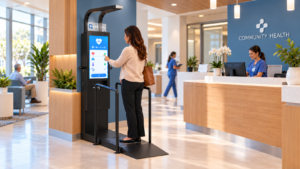
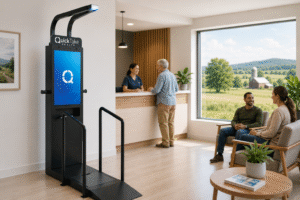
QuickTake Health was created to simplify how organizations capture and document routine health information. The platform uses a smart wellness assessment kiosk to guide users
through a quick, automated check-in experience.
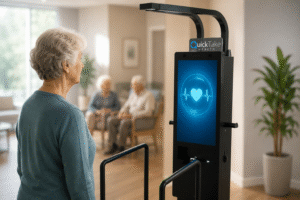
Through biometric sensors, camera-based technology, facial recognition, and a 32-inch touchscreen, the kiosk captures key health and wellness vitals, including:
- Blood Pressure
- Weight
- Height
- Body Mass Index (BMI)
- Pulse oximetry
- Heart rate
Once the assessment is complete, the information syncs securely into the connected electronic health record systems, mitigating manual entry.
This streamlines the entire intake process, making it faster, cleaner, accurate, and easier for teams to access when needed.
Where Automated Workflows Make the Biggest Difference
Some care environments perform health checks many times throughout the day. In these settings, even small documentation delays can add up quickly.
QuickTake Health supports routine assessments across:
- Senior living communities
- Athletic programs
- Clinics
- Wellness spaces
- Sports teams
Instead of relying on handwritten notes or repeated manual entry, the kiosk captures
measurements automatically and sends the data directly into the appropriate record. This reduces extra documentation steps while helping teams maintain a more consistent
workflow.
How Automation Supports Everyday Teamwork
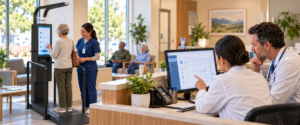
Many workflow delays happen before the appointment even starts. Staff members often spend valuable time collecting measurements, recording them on paper, entering them into electronic records, and checking for missing or mismatched information.
QuickTake reduces these repetitive tasks by completing key health measurements during one guided session.
The process helps teams by:
- Reducing handwritten
- Limiting repeated data
- Decreasing mismatched or missing
- Supporting quicker intake and check-in
- Allowing staff to spend more time assisting people instead of managing
This practical approach demonstrates how patient intake workflow automation
solutions can become part of everyday routines without creating unnecessary disruption.
How Consistent Documentation Improves Care Coordination
Consistency matters because every healthcare decision depends on reliable information.
When vital signs are captured differently across staff members, shifts, or locations, it can be harder to compare data and identify changes over time.
QuickTake follows the same measurement process every time. Since the kiosk performs each reading in a standardized way, organizations are less dependent on different
measuring tools or individual documentation habits. Consistent documentation can help organizations:
- Create cleaner health
- Support more reliable chart
- Improve visibility across multiple
- Make routine wellness assessments easier to
- Help care teams identify changes with greater
When healthcare professionals can trust the information in the record, coordination becomes more efficient across caregivers, departments, and care settings.
QuickTake Health at a Glance
| Feature | How It Supports Daily Work |
| Contactless health assessment | Simplifies the check-in experience |
| Biometric sensors | Captures key vital-sign measurements |
| Advanced camera technology | Supports guided automated assessments |
| Facial recognition | Helps streamline user identification |
| 32-inch touchscreen | Provides an easy-to-follow assessment process |
| Automatic data integration | Securely transfers results into connected health records |
| Automated documentation | Reduces manual data entry and repetitive administrative work |
Supporting Different Healthcare Environments
Different organizations have different documentation needs, but they all benefit from consistent and reliable data collection.
QuickTake Health has been deployed in athletic programs and senior living communities while expanding across broader healthcare environments. Its automated approach is
especially useful for organizations that perform frequent health assessments and want to reduce administrative burden without adding complexity.
Examples include:
- Senior living communities that perform regular wellness
- Athletic programs that require routine health
- Clinics managing daily patient
- Wellness centers conducting scheduled health
As organizations grow, standardized documentation helps maintain consistency across locations while supporting smoother operations.
Conclusion
Care coordination strengthens when healthcare teams can rely on accurate and consistent information every day. Manual documentation creates delays that take away valuable
attention from patient care. QuickTake Health simplifies vital-sign capture through smart health assessment kiosks that automate measurement, documentation, and secure data
integration into connected electronic health record systems.
By reducing repetitive administrative work and supporting standardized workflows across senior living communities, athletic programs, clinics, and wellness spaces, organizations
can improve efficiency while giving healthcare teams more time to focus on the people they serve.