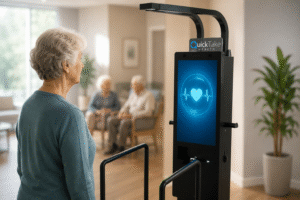
Rural Healthcare Modernization: A Better Rural Healthcare Experience Begins at the Front Door
When it comes to rural healthcare, there’s no doubt that there are challenges
For many rural clinics and hospitals, the challenge is not a lack of commitment. It is the daily reality of limited staff, long travel distances, high chronic disease needs, and workflows that still rely on paper forms, clipboards, and manual documentation.
When intake is slow, health vitals are recorded by hand, or patient data is scattered across systems, the entire care experience starts with friction.
A better rural healthcare experience begins at the front door.
That means faster check-ins, consistent wellness data, better patient engagement, and digital tools that help care teams focus on people rather than paperwork.
Why Rural Healthcare Needs Modern Workflows
Rural providers often serve patients who already face barriers to care. A simple appointment may require a long drive, time away from work, or limited access to nearby specialists.
Once the patient arrives, every minute matters. Typical workflow challenges look like:
- Manual intake forms
- Repeated patient questions
- Handwritten or delayed health vitals documentation
- Staff pulled away from higher-value clinical work
- Inconsistent data across visits or locations
- Limited visibility into chronic disease trends
These problems may seem small on their own. Together, they slow the system down.
Rural healthcare modernization is not about adding complicated technology. It is about making care easier to access, document, and act on.
What Rural Healthcare Modernization Actually Means
Modernization starts with mitigating the routine tasks that drain time from already-busy care teams.
When health vitals, intake questions, wellness check-ins, and patient education can happen through a structured digital workflow, rural clinics gain something important: consistency.
The goal is not to replace clinical judgment. The goal is to give clinicians cleaner, faster information.
A modern rural health workflow should help teams:
- Capture patient wellness data quickly
- Reduce manual documentation
- Improve chronic disease visibility
- Support patient education at the point of care
- Standardize processes across multiple locations
- Give staff time back during high-volume periods
What this really means is simple: less friction at the start of care and more clarity throughout the patient journey.
What a Rural Health Kiosk Should Deliver
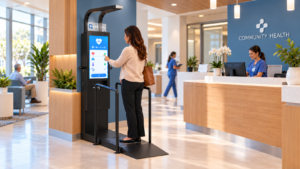
A rural health kiosk should make the first step of care easier and less complicated.
A self-service kiosk can guide patients through a simple wellness check, capture key health vitals, and send structured data into the organization’s documentation system.
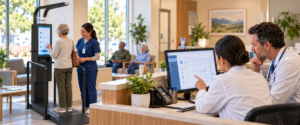
Instead of relying on clipboards, handwritten notes, or delayed entry, teams receive consistent, accurate, real-time information.
Here’s what an effective system should do:
1. Faster Intake
Routine health checks should not slow the entire visit. When measurements can be captured in seconds, patients move through the process more smoothly, and staff are not forced to repeat the same steps manually.
2. Consistent Health Vitals
Consistency is what makes health data useful. Weight, BMI, height, heart rate, pulse oximetry, blood pressure, and other wellness inputs become more valuable when captured routinely in the same way.
3. Cleaner Documentation
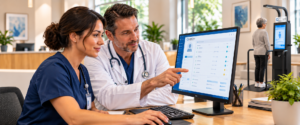
Manual documentation takes time, and every extra step creates room for error. Automated data capture helps reduce handwriting, retyping, missing information, and delayed entry.
4. Patient Engagement at the Point of Care
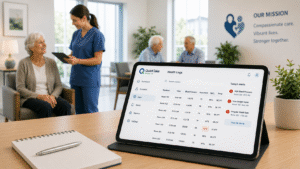
A guided kiosk experience gives patients a clearer role in their own health check. Real-time results, education, and digital access to wellness information can turn routine screening into a more meaningful touchpoint.
5. Support for High-Volume Rural Settings
Rural clinics need tools that are simple, durable, and easy to fit into daily operations. The best technology does not create another burden. It quietly solves one.
Where Rural Healthcare Automation Makes an Impact
Rural healthcare automation can support many parts of the care experience, especially when routine health data needs to be captured often and accurately.
These systems are now being used across:
- Rural Health Clinics
- Rural hospitals
- Community health organizations
- Pharmacies
- FQHCs
- Chronic care programs
- Preventive health screenings
- Wellness and outreach programs
Anywhere routine health checks matter, automation can improve clarity and reduce workload.
A Smarter Way to Support Rural Care
When health vitals are routinely captured the same way, rural care teams gain a stronger baseline.
Small changes become easier to notice. Blood pressure trends, weight changes, BMI shifts, and wellness patterns become easier to monitor when the data is captured in a structured way.
This is especially important in rural communities where chronic disease management, staffing capacity, and patient access are already major challenges.
Automation does not replace the care team. It gives them time back.
Staff can save time from chasing paperwork or manually documenting routine measurements and put it towards supporting patients directly.
For rural health networks, consistency also matters across locations. When multiple clinics are capturing patient data differently, it becomes harder to compare outcomes, track trends, and manage population health.
QuickTake helps create a standardized screening experience across locations, giving organizations a more reliable foundation for care delivery and reporting.
Building Rural Care Around Access, Not Friction
The future of rural healthcare will not be built by one solution alone.
It will be built through many small improvements that work together: faster intake, cleaner documentation, stronger patient engagement, better wellness data, and workflows that support care teams instead of slowing them down.
By automating routine health assessments and bringing digital wellness tools to the front door of care, QuickTake gives rural providers a simple way to modernize without disrupting the human side of healthcare.
Better access starts with a better first step.
Take the Lead in Rural Health
Rural healthcare teams are carrying some of the most important work in the country. They deserve tools that match that responsibility.
QuickTake replaces outdated, labor-intensive processes with technology designed for speed, consistency, engagement, and scalability.
Clean documentation. Faster movement. Better patient visibility.
That is what rural healthcare modernization should feel like.